SparkToro’s analysis found that 68.01% of Google searches in the US ended without a click during the first four months of 2026 up from 60.45% in 2024.
Website clicks and traffic significantly dropped after modern SEO (AEO, GEO) and platforms like ChatGPT and Perplexity. People now use search engines, AI answer engines, social platforms and online communities.
The statistics also show that search engines are changing and so are funnel strategies.Traditional funnels included clear stages from awareness, consideration, decision and conversion. But now AI tools can answer questions, compare brands and summarize research in seconds. Zero click results can also give users the information they need without a website visit.
It does not mean that SEO is dying but your old funnel strategies maybe. Ranking for keywords still matters but it’s not something that will blow your website with tons of traffic solely. Brands also need to appear in AI answers and build trust across search platforms. They need to create content for every stage of the customer journey but in a way that users can access.
We will explore how the search funnel differs from the marketing funnel in this guide. You will also learn about modern searches and funnel strategies that businesses can use to adapt new SEO strategies.
Search Funnel vs Marketing Funnel
A search funnel focuses on what that person searches for at each stage. Their searches may change as their needs become clearer. For example, the search of someone looking for seo service for law firm will go like this:
- How can I get more clients for my law firm?
- How does SEO help law firms?
- Best SEO company for law firms
- Law firm SEO services near me
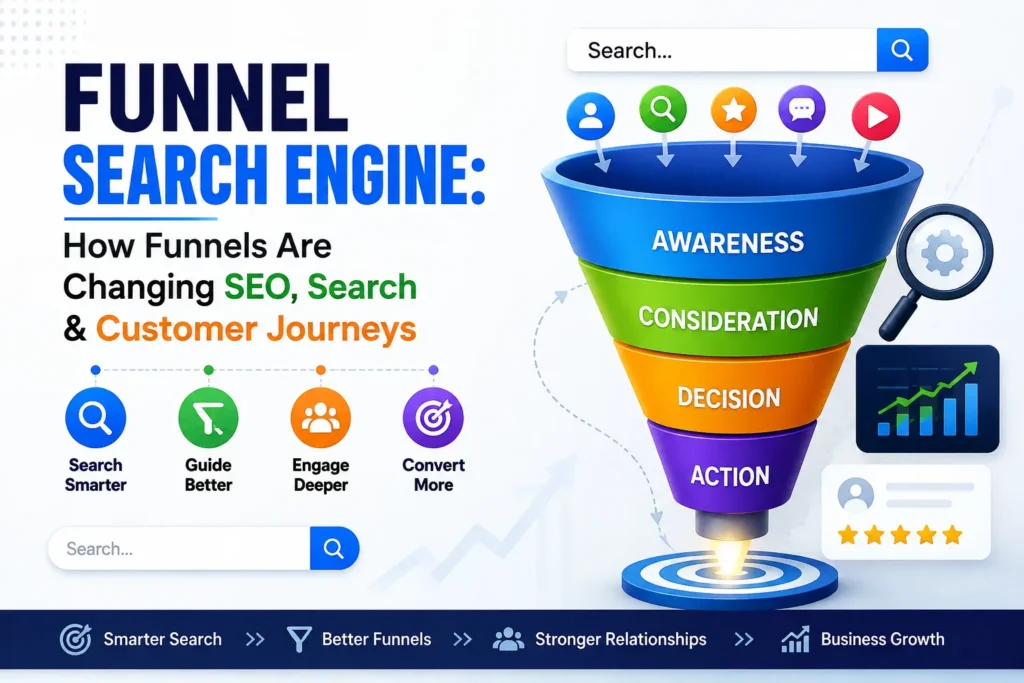
In comparison, a marketing funnel shows the stages a potential customer goes through before taking action. It usually starts with awareness and ends with a purchase or conversion. The main stages include:
- Awareness: The person discovers a problem or need.
- Consideration: They start looking for possible solutions.
- Decision: They compare options and choose one.
- Conversion: They take action such as making a purchase or booking a service.
Here is the detailed comparison between marking and search funnel:
| Comparison Point | Marketing Funnel | Search Funnel |
| Main focus | Focuses on the customer’s buying process. | Focuses on the customer’s search behaviour and intent. |
| Stages | Usually includes awareness, consideration, decision and conversion. | Covers search intent from informational to commercial and transactional. |
| Main purpose | Helps marketers understand where customers are in the buying process. | Helps SEO teams understand what users are searching for at each stage. |
| Content strategy | Helps decide what message, offer or content fits each stage. | Helps decide which keywords, topics and content types to target. |
| Customer behaviour | Look at how customers move closer to taking action. | Look at how search queries and intent change as customers get closer to a decision. |
| Channels | Can include search, social media, email, advertising and other marketing channels. | Can include search engines, AI answer engines, social search and other discovery platforms. |
| Measurement | Often measures engagement, leads, sales and conversions. | Can measure rankings, search visibility, clicks, AI mentions, leads and conversions. |
| Role in SEO | Provides a broader view of the customer’s position in the buying process. | Helps align SEO, keywords and content with the customer’s search needs. |
How AI Search Is Changing Funnel & SEO at Each Stage
The traditional funnel stages have not disappeared after modern funnels. People still move from awareness to consideration and then toward a decision. However, the way users move through these stages is changing.
AI search, zero-click results and other search platforms can now provide information before a user visits a website. This makes the modern funnel less linear. Here is how modern search funnel works and how they are changing SEO:
1. Top of Funnel (Rankings to AI Visibility)
The top of the funnel (TOFU) focuses on awareness. At this stage, users often have questions or want to learn about a problem. They would search for an answer, check the results, and visit a website for more information in the past.
But AI search now provides answers right in the search results. For example, AI Overviews can summarize information and show sources or brands. So it means users may discover a business without visiting its website.
SEO consultant Aleyda Solís has also noted that AI Overviews are changing the search funnel. As a result, TOFU SEO now needs more than keyword rankings. However, businesses should focus on:
- Creating clear and useful answers
- Building topic authority
- Providing accurate and trustworthy information
- Making content easy for search systems to understand
- Earning visibility and citations where possible
- Maintaining strong search rankings
Traditional rankings still matter. However, they are now one part of a wider search visibility strategy.
2. Middle of Funnel (Research to AI Assisted Consideration)
The middle of the funnel (MOFU) focuses on consideration. Users know what they need and start looking for the right solution at this stage. They may visit different websites, read blog posts, compare options and check reviews.
AI tools can now help with some of this research. Users can ask for comparisons, recommendations or quick summaries. This does not mean people stop researching. Instead some research now happens within search and AI tools. However, when creating MOFU content for your site, focus on:
- Providing accurate and useful information
- Building strong brand authority
- Creating clear comparison content
- Building a positive reputation
- Earning relevant third-party mentions
- Supporting claims with reliable evidence
This helps your brand stay visible while users compare their options.
3. Bottom of Funnel (High Intent, Low Clicks)
The bottom of the funnel (BOFU) focuses on decision and conversion. People at this stage usually have a clearer idea of what they need and are closer to taking action.
AI and zero click search can still affect this stage. People may research a business, check its reputation or compare providers before visiting its website. However, high intent searches can still bring users directly to service pages and other conversion focused pages. This makes the quality of the final conversion experience important. You should focus on:
- Strong service pages
- Local SEO
- Clear calls to action
- Trustworthy branding
- Positive reviews
- Well-structured information
- Simple conversion paths
The key difference is that users may reach the bottom of the funnel after completing more of their research elsewhere. But they are potential leads.
Are Funnels Going to Replace Search Engines?
No. Funnels will not replace search engines. Instead AI powered search is changing how people move through the funnel. You can now get answers, compare options and discover brands through AI. So you just need to update funnels for GEO, AEO and AI chatbots. But Neil Patel predicted,
“SEO is drifting more and more toward search everywhere optimization and less search engine optimization”
How to Build an SEO Strategy Around the Search Funnel
As search becomes more complex, SEO needs to go beyond traditional rankings. Here are some key ways of adapting to new search engines while doing SEO:
- Optimize for Both Search Engines and AI
Traditional SEO still focuses on rankings, organic results, featured snippets and local search. However, AI search shows content in AI-generated answers, citations, and recommendations. These approaches overlap but they are not exactly the same. A strong SEO strategy should therefore focus on both traditional search visibility and AI visibility.
- Create Content for the Full Customer Journey
You should build content around the different needs of your audience instead of publishing unrelated blog posts. Your content can cover:
- Informational questions
- Problem solving topics
- Comparisons and evaluations
- Service information
- Conversion-focused pages
This creates a connected content journey. It also helps users find the right information as their needs change. Semrush also conducted a study to find the impact of AI on SEO traffic in 2025. They described that AI traffic has 4.4 times higher conversion rates so you have to be there on AI platforms to convert.
- Make Content Easy to Understand
Search engines and AI systems need to understand what a page is about. Clear content structure can help so use:
- Clear headings
- Direct answers
- Simple language
- Accurate information
- Relevant structured data
- Strong internal links
- Clear author and business information
Structured data allows search systems to understand page information but it does not guarantee AI citations or recommendations.
- Connect the Funnel With Internal Linking
Internal linking can connect different stages of the search funnel. You can link it to related guides, service pages and conversion focused pages.
For example, an informational blog can link to a related guide. The guide can then link to a relevant service page. It can lead users to a consultation or contact page.
- Measure More Than Rankings
Modern SEO cannot be measured by keyword rankings alone. As users get answers from AI tools and zero click search results so you should also monitor:
- Organic traffic
- User engagement
- Returning visitors
- Leads
- Conversion rates
- Assisted conversions
- Content that contributes to conversions
- Brand mentions and AI visibility where measurable
These metrics provide a broader view of how SEO supports the customer journey and business growth.
- Build Visibility Beyond Your Website
Modern search does not happen only on Google. People also discover information through YouTube, Reddit, social platforms, review sites and online communities. Building a presence on relevant platforms can strengthen brand visibility and authority. It also gives people more ways to discover and research a business before they visit its website.
Common Mistakes in Funnel-Based SEO in 2026
A funnel-based SEO strategy can help businesses reach users at different stages of their search journey. However, a few common mistakes can limit its results:
- Targeting Only Bottom of Funnel Keywords: Focusing only on high intent keywords can cause businesses to miss people who are still researching. Content should also target users at earlier stages of the funnel.
- Content Without Connection: Publishing random content can leave users with no clear next step. Use relevant internal links to connect different funnel stages.
- Ignoring Search Intent: Ranking for a keyword does not guarantee that the content answers the user’s question. Match each page with the intent behind the search.
- Focusing Only on Traffic: High traffic does not always lead to more customers. Track leads, conversions and other metrics that show business results.
Conclusion
Search is no longer a simple path from a keyword to a website visit. AI search, zero-click results and social platforms have changed how SEO works a bit. Everything from how people discover information and move through the customer journey has changed.
So the traditional funnel is becoming less linear. SEO now needs to cover every stage from early research to final decisions. Businesses should create useful content, match search intent, build authority and stay visible across both traditional and AI search. A strong funnel based SEO strategy focuses on visibility, trust, engagement and conversions across the entire customer journey.
FAQs
What is a Funnelback search engine?
Funnelback is an enterprise search and content discovery platform from Squiz. It helps organizations search information across websites, intranets and other content sources from one place.
Can SEO still work if users do not click on websites?
Yes, SEO can still build brand visibility and trust through search results, AI answers and other search features.
How can businesses prepare for changes in search behaviour?
Businesses should create helpful, trustworthy content and strengthen their brand authority across search engines.